.

Промоакции для игроков не только в шутерах — воспользуйся промокодом Vavada от наших партнеров и получи бонусы, которые подарят азарт и атмосферу, сравнимую с игровыми победами.

.

Tokaido

I tried Tokaido this weekend. It was an appallingly awful experience, but I am led to believe it could be better.

I played a five-player game using the Crossroads expansion. Those links will explain why that is a bad idea. Between the two, you pretty much have Candyland with vastly more complexity and a small bit of strategy.

After playing, I looked at reviews of Tokaido, and almost every one quickly said that the game is not Candyland. That is a lot of smoke for there not to be fire. In the game I played, the range of sane decisions was small, the randomness of the results was large for most squares, and most players were new so we did not even know the range within which randomness occurred. My random character was from the expansion and depended on that randomness, and then I got boxed out of even using most of it due to pawn placement. Such is life. I just repeated as a mantra, “it’s Candyland,” because how much can you care when your decisions have almost no impact on your outcomes?

So pausing here, I would be interested in playing again, but with no more than three players, not using an expansion, and I want a chance to read the cards so I know what the experienced players are basic their decisions on. Having started with two paragraphs of complaints linking to two pages of complaints, why would I be interested in playing again? < --more-->

Tokaido is thematically lovely. It is an equal and opposite of Blood Rage, where a peaceful theme plays into the mechanics. The goal of Tokaido is to walk along the coast. Whoever has the most fun wins. That is literally what you are scoring; whoever has the best time meeting people, visiting seeing the sights, and buying souvenirs wins the game. The visuals are peaceful and elegant. Gameplay is just moving along a line and picking up cards. It is a nice idea.

At a level beyond Candyland, there is cutthroat tactical play. Where you place your pawn matters, and people can aggressively block each other to thwart each others’ goals. Once you know what is hidden in all those decks of cards, you can rationally gamble on the outcome of picking squares with random results. There is gamer play here as well as casual play.

Make sure to have excellent lighting. The other great problem we had was just seeing what was going on. The icons are very small, and several of them are similar. In low lighting, there is not a lot of difference between gray and light blue, especially with glasses like mine. “Is that a hot spring or a view of Mount Fuji?” Tokaido is also one of those games that uses icons in place of words, most of which are good, but some of which only make sense if you already know what they mean. (The worst of that was probably the Crossroads expansion, which I will again curse. One of my friends was enthusiastic because one part helped solve a cash flow problem he had with his shopping-centric strategy; more than doubling the complexity of the game to add exactly six yen is a really bad trade-off.)

I like the idea of the game, and several people were enthusiastic. Under the right circumstances, it looks like it could be a good game.

: Zubon

[TT] Icons and Text

Many Eurogames seem to be minimizing text in favor of icons. This makes sense given an international market; if you are selling your Eurogames in Europe, you have a dozen languages to contend with, and if you are aiming for the lucrative markets in North America or east Asia, having lots of German text will not help your sales. Sadly, many of these icons are horrible, maybe meaningful if you already know what they mean.

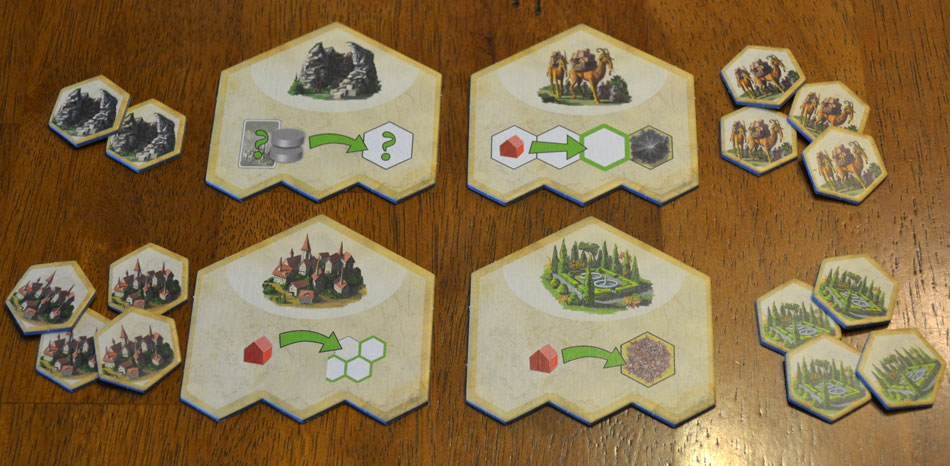
For example, Kingdom Builder explains what location tiles do using an arrow for “move” and a somewhat curved arrow for “place.” You will be forgiven for remembering that backwards, and good luck seeing the curve from across the table. And then some do not follow that format, and expansions add more symbols. The icons are an okay reminder if you already know what the location tiles do, but if you do not, they will not help you unless that tile follows the standard format and is close enough to be clearly visible.

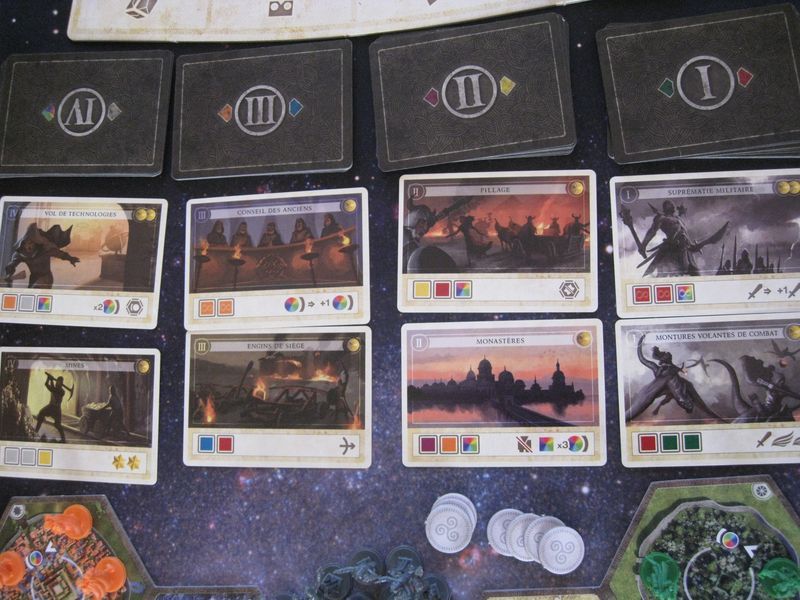
For example, Hyperborea uses truly awful symbols to explain what technologies do. As with Kingdom Builder, some follow a basic format that is easy to understand. Some have tiny variations. Some have unique symbols that do not appear elsewhere and may not be explained anywhere. You have not overcome the language barrier if players are having a five-minute debate using inferential logic to figure out what a symbol is supposed to mean. Given the number of similar but slightly differing technologies, these do not even serve as much of a reminder.

very small icons from the Tokaido board game For example, Tokaido has three space types that are mixtures of gray and light blue, some in close proximity and sometimes rotated on the board. The accompanying symbols for each space are measured in millimeters.

My favorite linguistics blog has an entire category for what it calls “nerdview.” This is described as “writing in technical terms from the perspective of the technician or engineer rather than from a standpoint that would seem useful to the customer or reader” or “a linguistically misleading communication in which the failure is not of grammar or meaning but of failing to keep in mind the viewpoint of the reader rather than the specialist (possibly nerdy) view of the writer.” More simply, the symbols make perfect sense if you are the game developer, but they can be incomprehensible for someone trying to learn the game. We have previously discussed MMO icons that are about 10 pixels across and hide multiple sentences of information. They can actually make perfect sense to a veteran player who can tell at a glance the fine distinction between a dragon and a fire-breathing drake. Players newer or less visual may be stymied.

I appreciate the attempt to internationalize the game with a standardized appearance. I sometimes question the effectiveness of the solution.

: Zubon

Low Hanging Design Fruit in Online Card Games

I’m trying Magic Duels, and the story mode is mostly bad. You do not get to pick your cards, and they change after every win, so you do not even know what they are in advance. In theory, this means the difficulty of your deck and your opponent’s can be finely tuned to face each other. Because luck of the draw is a large factor, you can do exactly the same thing two games in a row and either win undamaged or lose before you get a fourth land (or draw a fourth card other than a land). Part of the point of CCGs is that you control the randomness through deck design. When the game controls your deck and what random cards are available to each side, your skill as a player is dwarfed by factors outside your control. And then the white deck is tuned and stacked for guaranteed wins, plus tutorials inside in tutorials.

The particular bit of randomness that is galling me is mana flood/screw. Streakiness is an aspect of true randomness, more so than most people believe. It is a fact of life in physical card games because you cannot get a relatively even spread of land throughout a deck without stacking the deck. But you know what computers can do? Randomize within limits. They can be programmed with rules like, “If a deck has 20/60 lands, the deck should not have 5-card streaks of all lands or no lands.” The lands need not be evenly distributed throughout the deck; toss in a bit of randomness to keep it from being predictable, it’s a card game. But if you have a computer that can keep the most ridiculous extremes of randomness from happening, why would you let them happen other than thinking that is a feature of the game? “Yeah, the dice came up that you had a near-guaranteed win/loss. Great game, eh?”

I have won games because my opponent did not draw a third land until its health was in the single digits, and I have lost games because of drawing 12 lands by turn 10. Neither of these were good games, and these are entirely preventable problems when a computer is in charge of the deck.

: Zubon

Tesla vs. Edison: War of Currents

Artana had a big booth dedicated to Tesla vs. Edison at Gen Con, and the game certainly merits trying. I have just the one playthrough under my belt, but everyone enjoyed it. The game supports multiple parallel and conflicting strategies and mechanics on the path to victory.

The theme is dear to nerd hearts: the competing current standards and the electrification of America. Tesla is a geek hero, so players are naturally drawn to him, with Edison cast as the villain. The game remains neutral on that question, although Edison’s special ability is to ignore patents. The potential player characters also include three lesser names in electricity.

You are running an electric company. Your company founder gives you certain stats and abilities. Supporting luminaries are recruited via bidding. Each round, you and your luminaries can research technology, build a project, engage in propaganda, or play the stock market. You are competing not only for science but for hearts and minds, as the value of your stock is affected by whether the public thinks AC or DC is the current standard of the future. Yes, people have strong opinions about that. At the end of the game, whoever is holding the most valuable stock portfolio wins. (You start with four shares of your own stock, so unless you are pursuing a very aggressive stock market game, highest stock value should tend to win.)

The strategy comes from which actions to pursue and in what order. Continue reading Tesla vs. Edison: War of Currents

Honest Deception

I finally got a copy of Coup at Gen Con, not a new game but one I enjoy. Coup is a game of bluffing, deduction, and assassination. You have two hidden cards that give you abilities, but feel free to lie about what two they are and use whatever abilities you like. If you are called on the bluff, you lose a card; if you are challenged but were telling the truth, your challenger loses a card.

Playing a bit at Gen Con, I found that I am better at telling the truth unbelievably than lying believably. This is a drawback for Mafia/Werewolf, but it works brilliantly in Coup. If I never bluff, I have no tells that indicate I am bluffing. But he could not really be telling the truth every time in a bluffing game, could he? Especially when you get a really unlikely draw, like two of the same card, or when you use the Ambassador to pick an unlikely pair of cards rather than a powerful pair.

And if I can train everyone to believe that I never bluff, I have free reign to start bluffing…

: Zubon

Friendly Kickstarters

Two Kickstarters to point out from friends of the greater rat-slaying community:

Project Gorgon is back on Kickstarter and has already met its goal. The $35 and $50 tiers look like your best bang for your buck. We have occasionally blogged about Gorgon as a boutique MMO, with lots of interesting ideas.

Cultists of Cthulhu is a game in the category of Arkham horror, cooperative with one or more cultists waiting to betray the team. If you are like me and like to judge based on the rules, they are online. It advertises meaningful decisions in bold text, so the game is in the spirit of what we love here, although I cannot speak to the execution. The add-ons look rather pricey.

: Zubon

One Night Ultimate Werewolf

Given my recent binging on online Mafia, I was keen on seeing Bezier Games, the Ultimate Werewolf folks. Like Town of Salem, One Night uses a variety of roles with special abilities, and the One Night variation advertises itself as no moderator, no elimination, no boring parts. It has proved popular enough to get an expansion (Daybreak) and a spinoff (One Night Ultimate Vampire). My impressions are based on game demos at Gen Con, not deep and repeated play.

One Night achieves “no moderator” via app. You tell your phone/tablet which roles are in play, hit the start button, and it reads off who should open their eyes when. That works well, assuming you can operate within strict time limits. Even with strict time limits, this is a long section of the game. At least a third of the game will be spent with your eyes closed while things happen outside your control or knowledge. That seems to concatenate the boring parts, rather than eliminating them, although there is some excitement because you know that mysterious and important things are happening on the other side of your eyelids.

The physical implementation of this stage is difficult, especially with a large group or short people. Playing at a con helps because there is background noise and movement. In a more intimate game, it will be difficult to avoid noticing who is reaching across the table as roles are called out. Werewolf/Mafia is not meant advantage long arms, narrow shoulders, and quiet chairs.

This nighttime phase is either brilliant or horrible, but I am undecided on which. About half the roles involve changing roles. The Robber swaps roles with someone else, the Drunk swaps roles with a center card (without looking at it), the Troublemaker swaps others’ roles, and more. You not only do not know who is on your team, you do not know which team you are on. The Insomniac has the surprisingly strong power of just checking her role at the end of all that swapping. Part of me wants to say this is horrible random chaos. Part of me wants to say this brilliantly expands the daytime game of deduction to including deducing your own role, so you should expect to see someone suddenly realize she is no longer a Werewolf. A good Troublemaker can evoke that moment, and a great one can lie, get a Werewolf to reveal herself, reveal whose cards she really swapped, then convince the rest of the village to lynch the Werewolf. All in 5 minutes or less.

Eliminating the nighttime elimination mechanic wonderfully eliminates the “you randomly sit out this game” effect. It also quietly changes a fundamental mechanic while keeping the fluff. Werewolf is no longer a killing role; it is now entirely a hiding and lying role. Those people who want to be Werewolf/Mafia because that is the active killing role? I wonder how long it takes them to notice that the Werewolf does not kill anyone, instead just hiding from the villagers.

I have not tried One Night Ultimate Vampire. I am told that it removes the team-swapping in favor of a similar goal-changing mechanic: vampires are always vampires, but now you are in love with that mortal and need to keep him alive at all costs.

: Zubon

[MtG] Duels: Origins – Pain and Gain

There’s a new Stainless produced Magic the Gathering game out on Steam and Xbone after having started earlier in July on fancy i-Things. It no longer follows the earlier naming conventions of Duels 201X, and now it is simply called Magic Duels. Even watching hipster Magic players get to romp around a few weeks before me, there has been a lot of salt that has hampered a really good trajectory that Stainless is taking the game.

The Free-est MtG

Magic Duels is free-to-play. Of course you are instantly wondering where’s the catch or paywall. In Magic Duels, which slightly mirrors the paper card game, the gaining of new cards is in the form of boosters. 150 gold per booster, and each booster gets 3 commons, two uncommons, and a rare+.

Playing the story (more on that), playing random matches, and doing daily quests all net you more gold. The limit is 400 gold gain / day, which is more than 20-25 games / day. You can of course spend some cash to get more gold. Very Hearthstone-y. Continue reading [MtG] Duels: Origins – Pain and Gain

Shopping

The vendor hall is one of the big draws at Gen Con. See the latest games, get the latest games, look for discounts or stuff you did not know you wanted but now desperately need. I seem to be unusual in that I can say, “I should not spend money on this,” and then I do not spend money on it.

For my friend group that attends Gen Con, the vendor hall is more or less what they do. You can spend all day playing demos with the developers. You can learn classic games you have not played, try the latest releases, and even try games that are still in development. Last year we loved Asmodee and Hyperborea. This year, friends are all about Cryptozoic and keep saying, “Attack on Titan is in hard alpha.”

I find myself in the Steam sale dilemma. I have trained myself not to buy (almost) anything on Steam unless it is 75% off or I will play it that day. I tend to group game prices at Gen Con into three brackets:

  1. Full price, new release or early release: potential buy because it is not available elsewhere and we likely will play it tonight
  2. Full price, 30% off on Amazon: do not buy unless I know we will play it tonight. Fun now is worth some money, but otherwise I can have it delivered to my house before I would otherwise play it. The later we get it in the con, the less likely we are to play it tonight because of games from #1.
  3. Discount, better than I can find on Google in a minute: potential buy, double bonus if it is an older game/book that is hard to find at a reasonable price and it is on discount

That is for commodities like boxed games you can get from dozens of sources (although the con sponsors reportedly have it in the contract that they get exclusive rights to sell their stuff in the vendor hall, which means almost everything from Paizo and Mayfair is in #2). If you are looking at clothing and game accessories, you might prefer to try them in-person rather than shopping online, and many people start wearing those hats, goggles, T-shirts, and everything else immediately.

And I remain resolved to get Geek Chic furniture for my next home.

: Zubon